

Updated October 2026: this guide has been rebuilt for the 2026-27 program year, with current Queensland nomination, employer sponsored, DAMA, PALM and National Innovation visa information.
Queensland has long been a destination chosen by many migrants when they come to Australia. With a high standard of living, Queensland boasts:
- a stable economy
- affordable housing
- world class education and advanced health services
- modern roads and public transport infrastructure
- a safe environment for you and your family to live
- perfect beaches, national parks, and the outback experience
- a subtropical and tropical climate
- a vibrant cosmopolitan, arts, and cultural scene
- an eclectic mix of friendly cultures ready to make you feel at home
- it is the only state in Australia with six international airports.
There is a wide range of visa options available for migrants to move to Queensland, depending on their particular situation.
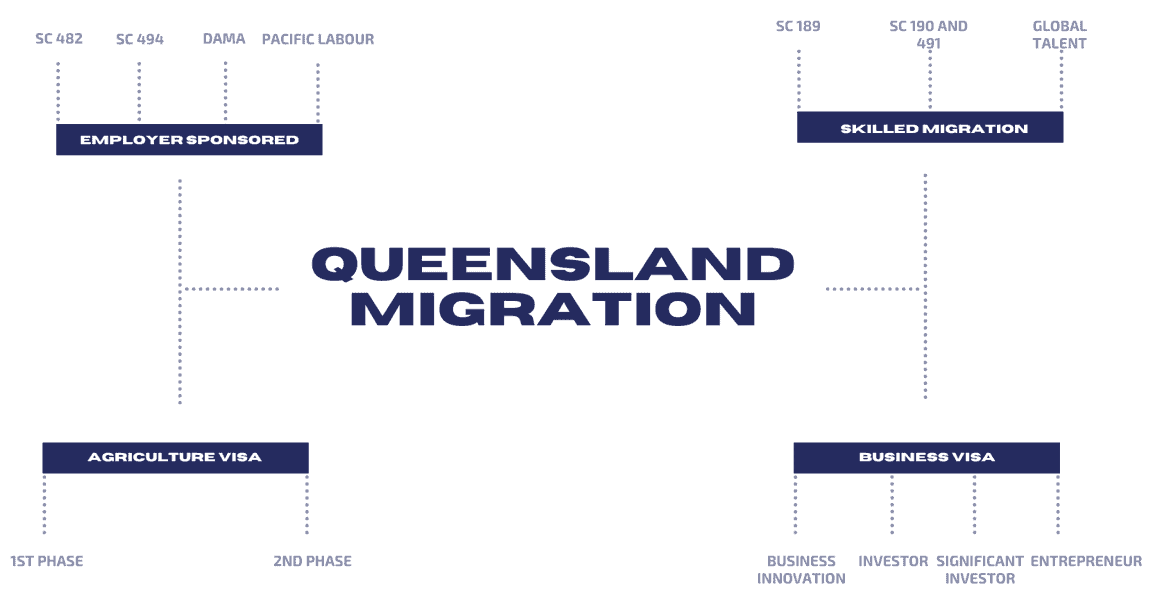
The image above was made in 2022 and includes some programs that have since closed or changed. The current options are explained below.
Information current as at November 2026. Queensland’s 2026-27 state nomination program opens for Registrations of Interest on 6 November 2026. The 2026-27 settings below are as announced, so check the latest position before you act.
Queensland visa options at a glance (2026-27)
| Pathway | Visa | Who it suits | Permanent? |
| State nomination | Subclass 190 | Skilled workers with an occupation on a Queensland list, living in Queensland or offshore | Yes |
| Regional state nomination | Subclass 491 | Skilled workers willing to live and work in regional Queensland (outside Greater Brisbane) | Provisional (5 years), PR through the 191 |
| Employer sponsored | Skills in Demand 482 | Workers with a Queensland employer willing to sponsor them | Temporary (up to 4 years), PR through the 186 |
| Regional employer sponsored | Subclass 494 | Workers with an employer in regional Queensland | Provisional (5 years), PR through the 191 |
| Permanent employer sponsored | Subclass 186 | Workers whose employer offers a permanent role | Yes |
| DAMA (labour agreement) | 482, 494 or 186 | Workers in Far North Queensland or the Townsville and North West region, including some lower skilled roles | Depends on the occupation |
| PALM scheme | Subclass 403 (PALM stream) | Workers from nine Pacific countries and Timor-Leste with an approved employer | No |
| Exceptional talent | National Innovation visa 858 | People with an internationally recognised record of exceptional achievement | Yes |
| Study, then work | Student 500, then Graduate 485 | Students who want a Queensland degree and post-study work rights | No, but leads to skilled pathways |
EMPLOYER SPONSORED VISAS
Skilled Employer Sponsored Regional (Provisional) visa (subclass 494)
You need to have an eligible employer in regional Queensland to sponsor you under the 494 visa. All of Queensland outside Greater Brisbane counts as regional for this visa, including the Gold Coast, Sunshine Coast, Cairns, Townsville and Toowoomba. You and your employer will need to meet the following requirements.
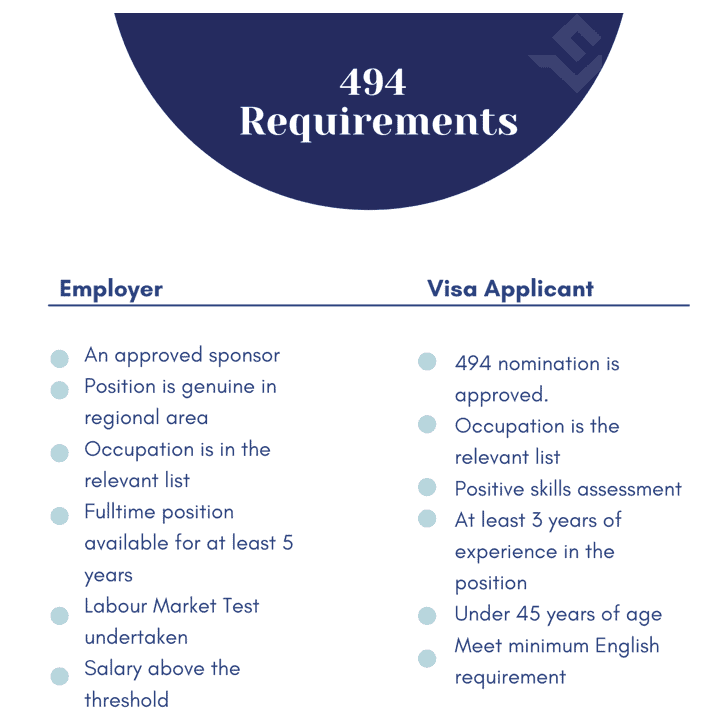
Image shows the 2022 requirements; see the current requirements below.
Main 494 requirements in 2026-27
- A nomination from an approved sponsor for a genuine position located in regional Queensland.
- An occupation on the Regional Occupation List for the 494 (or one covered by a labour agreement or DAMA).
- Under 45 years of age when you apply, unless an exemption or a labour agreement concession applies.
- A positive skills assessment and generally at least three years of relevant full-time work experience.
- At least competent English.
- A salary at the annual market salary rate, and at least the Core Skills Income Threshold of $79,423 (from 1 July 2026).
- The visa lasts five years. You must live and work in regional Australia while you hold it.
Visa subclass 494 is a pathway to visa subclass 191, which is a permanent visa, if you have lived and worked in regional Australia for at least three years and meet the 191 income requirement. Regional visas are among the higher priority groups for processing under Ministerial Direction 122 (from 19 September 2026). For more information about visa subclass 494, please click here.
Skills in Demand visa (subclass 482)
The Skills in Demand (SID) visa replaced the Temporary Skill Shortage (TSS) visa on 7 December 2024 and kept the subclass number 482. It is a popular option for migrants who do not meet the requirements of subclass 494 or other permanent visas, and your employer can be anywhere in Queensland, including Brisbane. It has three streams:
- Specialist Skills stream: for highly paid roles earning at least the Specialist Skills Income Threshold of $146,576 (from 1 July 2026). Most occupations are eligible, but not trades workers, machinery operators and drivers, or labourers.
- Core Skills stream: for occupations on the Core Skills Occupation List (CSOL), with a salary at the market rate and at least the Core Skills Income Threshold of $79,423 (from 1 July 2026).
- Labour Agreement stream: for roles covered by a company, industry or DAMA labour agreement, including the Queensland DAMAs below.
Main 482 requirements
- Your employer must be an approved standard business sponsor and nominate a genuine position.
- Labour market testing is required unless an exemption applies.
- Generally at least one year of relevant work experience in the last five years, plus a skills assessment for some occupations.
- English at the level required for the stream, and health and character requirements.
- The visa can be granted for up to four years in all streams.
- If you stop working for your sponsor, you have up to 180 days at a time (365 days in total) to find a new sponsor, apply for another visa or leave Australia.
- Every stream has a pathway to permanent residence, usually through the 186 Temporary Residence Transition stream after two years with your sponsor (see SID 482 path to PR).
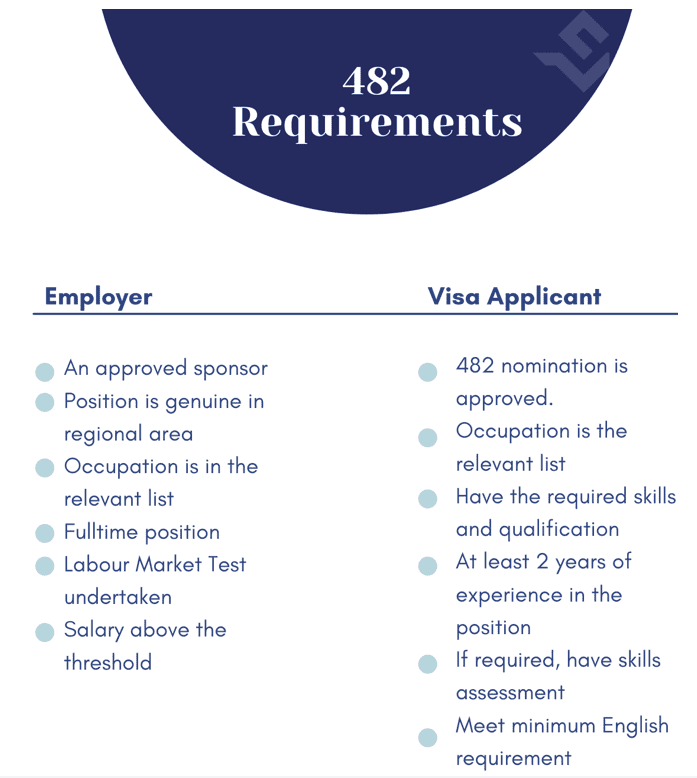
Image shows the former TSS visa requirements (2022); see the current Skills in Demand requirements above.
For more information about visa subclass 482, please click here
482 Visa And Subclass 494 Employer Sponsored Regional Visa Comparison and Permanent Visa Pathways
Employer Nomination Scheme (subclass 186)
The 186 visa is a permanent employer sponsored visa. Your Queensland employer nominates you for a permanent, full-time role through one of three streams:
- Temporary Residence Transition stream: for 482 holders who have worked for their sponsor for at least two of the last three years. Since 25 November 2023 any occupation can be used for this stream (see 186 TRT stream).
- Direct Entry stream: generally for applicants under 45 with a positive skills assessment, at least three years of relevant experience, competent English and an occupation on the CSOL.
- Labour Agreement stream: for workers sponsored under a labour agreement, including the Queensland DAMAs.
The salary must be at the market rate and at least the Core Skills Income Threshold of $79,423 (from 1 July 2026).
Labour Agreement
Labour Agreements enable approved businesses to sponsor skilled overseas workers when they have a workforce shortage that cannot be met by Australian workers or standard visa programs.
There are five types of Labour Agreements: Industry Specific, Company Specific, Designated Area Migration Agreement (DAMA), Global Talent Employer Sponsored (GTES) and Project Agreement.
- Industry Specific : terms and available concessions are agreed by Government at an industry level. Industry agreements include Aged Care, Dairy, Fishing, On-hire, Meat, Pork, Restaurant (premium dining), Minister of Religion, Advertising and Horticulture.
- Company Specific: terms and concessions are negotiated on a case-by-case basis.
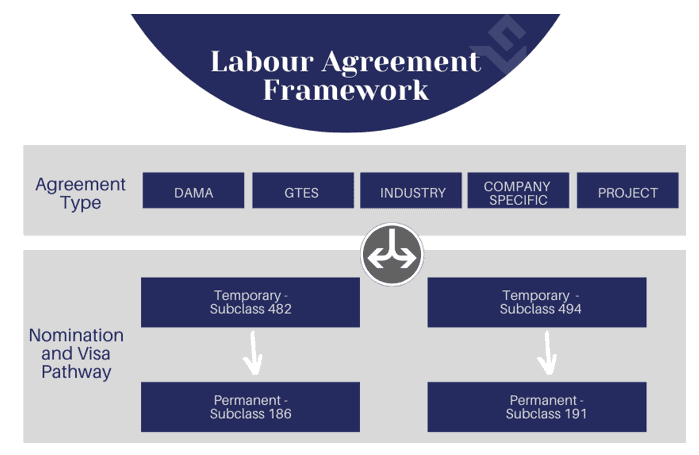
- Designated Area Migration Agreement (DAMA)
- A DAMA is an agreement between the Australian Government and a regional, state or territory authority known as a Designated Area Representative (DAR).
- It provides access to a broader range of overseas workers than the standard skilled visa programs, to fill recognised labour shortages in specified areas.
- DAMAs may offer concessions for visa criteria, such as English language, salary, skills and age requirements.
- Each agreement has a skilled occupation list specific to the DAMA which can be varied in accordance with identified labour market needs.
- DAMAs are designed to assist industries such as agribusiness, hospitality & tourism, health, construction & mining, defence, space, and innovation.
- DAMA Process

DAMAs covering Queensland
Queensland has two regional DAMAs. Your employer must be located in the DAMA area and must first be endorsed by the DAR before applying to Home Affairs for a labour agreement. Workers are then nominated and apply for a 482, 494 or 186 visa under the Labour Agreement stream.
| DAMA | Designated Area Representative | Area covered | Key points |
| Far North Queensland DAMA | Cairns Chamber of Commerce | Cairns, Douglas, Mareeba, Tablelands, Cassowary Coast, Cook, Croydon, Etheridge, Torres and Northern Peninsula Area council areas, and Weipa | Head agreement extended to April 2027 (announced January 2025). Occupation and concessions list last updated July 2026. |
| Townsville North Queensland DAMA | Townsville Enterprise | Townsville, Hinchinbrook, Charters Towers, Burdekin, Mount Isa, Cloncurry, McKinlay, Richmond and Flinders council areas | Around 200 occupations on its list. Salary concession of up to 10% below the income threshold for some occupations. |
Typical concessions under the Queensland DAMAs
- Access to occupations at skill levels 1 to 5, including some semi-skilled roles not available under standard visas.
- Higher age limits for permanent residence (generally under 50 or under 55, depending on the occupation’s skill level).
- Reduced English requirements for some occupations.
- Salary concessions for some occupations where market rates are below the income threshold.
- Reduced work experience requirements for some occupations.
- A pathway to permanent residence through the 186 visa for most occupations, usually after two years of work in the DAMA area.
Concessions are set occupation by occupation, so check the current DAMA list for your role. A possible Queensland-wide DAMA was raised during the state’s 2026 consultation, but nothing had been announced as at October 2026. For employers in Cairns and Townsville, see our Cairns and Townsville pages.
For more information about the Labour Agreement scheme, please click here
Pacific Australia Labour Mobility (PALM) scheme
The Pacific Labour Scheme and the Seasonal Worker Programme were combined into the Pacific Australia Labour Mobility (PALM) scheme in April 2022. PALM is now the main program for Pacific and Timor-Leste workers, and Queensland’s farming, meat processing, tourism and care sectors are major users of it.
- Who can take part: citizens of Fiji, Kiribati, Nauru, Papua New Guinea, Samoa, Solomon Islands, Timor-Leste, Tonga, Tuvalu and Vanuatu, recruited through their home country’s labour sending unit.
- Short-term placements: up to nine months in any 12-month period, mainly for seasonal work such as harvesting. A multi-year visa lets workers return each season for up to four years.
- Long-term placements: one to four years in a single placement, for ongoing low-skilled and semi-skilled shortages in rural and regional Australia and in some sectors elsewhere.
- Visa: workers apply for the Temporary Work (International Relations) visa (subclass 403), PALM stream, with a job offer from an approved employer.
- Employers: must be approved as a PALM scheme employer by the Australian Government (the scheme is administered by the Department of Employment and Workplace Relations, working with DFAT) and must also be approved as a temporary activities sponsor by Home Affairs.
- Family: eligible long-term workers can bring a partner and dependent children. Short-term workers cannot.
- Permanent options: PALM itself is temporary. Pacific and Timor-Leste nationals can enter the ballot for the permanent Pacific Engagement Visa (subclass 192), which has up to 3,000 places a year.
Former programs (closed): the Pacific Labour Scheme (led by DFAT, up to three years) and the Seasonal Worker Programme (up to nine months a year) no longer take new participants under those names. Their settings now sit within PALM.
Australian Agriculture Worker visa (did not proceed)
On 23 August 2021 the then Government announced the Australian Agriculture Worker visa for primary industries such as horticulture, meat processing, dairy, wool, grains, fisheries (including aquaculture) and forestry. In 2022 the new Government decided not to continue it as a separate program and to expand the PALM scheme instead, so it is not an option as at October 2026. For farm and food processing work in Queensland today, look at PALM, the Working Holiday visa (specified work), industry labour agreements such as the Horticulture, Meat and Dairy agreements, and the Queensland DAMAs.
Skilled Migration to Queensland
If you have skills and qualifications in an occupation on a relevant list, you can apply for a points-tested skilled visa. Migration Queensland (Business and Skilled Migration Queensland) nominates skilled workers for the Skilled Nominated visa (subclass 190) and the Skilled Work Regional visa (subclass 491). You can also apply for the Skilled Independent visa (subclass 189) without nomination and live in Queensland.
2026-27 program status and allocation
- Queensland’s 2026-27 State Nominated Migration Program opens for Registrations of Interest (ROIs) on 6 November 2026. Everyone must lodge a new ROI for 2026-27, even if you registered in an earlier year.
- Five pathways are offered: skilled workers living in Queensland, building and construction workers, Queensland university graduates, skilled workers living offshore, and small business owners in regional Queensland (491 only).
- Onshore applicants must have lodged their 2025-26 tax return and received their ATO Notice of Assessment before lodging an ROI.
- Queensland’s 2026-27 allocation has not been published yet. In 2025-26 Queensland received 1,850 places for the 190 and 750 places for the 491 (2,600 in total, confirmed 18 November 2025), up from 1,200 in 2024-25.
- The 2026-27 Queensland lists have been released: 209 occupations on the onshore list (up from 201) and 97 on the offshore list (down from 113). If your occupation is not on the list for your pathway, you are not eligible. See our Queensland skilled occupation lists page.
- Nomination fees for 2026-27: $630.30 (including GST) for onshore applicants and $573 for offshore applicants. The fee is paid only after you are invited to apply for nomination, and it is not refunded.
How Queensland nomination works
- Get a positive skills assessment in your nominated occupation and an English test result (at least competent English).
- Lodge an Expression of Interest (EOI) in SkillSelect for the 190 or 491 with Queensland as your preferred state.
- Lodge a Registration of Interest (ROI) with Migration Queensland under the pathway that fits you. A new ROI is needed in each program year.
- If Migration Queensland selects your ROI, you are invited to apply for nomination and have 14 days to lodge it with your documents.
- If you are nominated, you receive a SkillSelect invitation and have 60 days to lodge your visa application with Home Affairs.
Minimum requirements in every pathway
- At least 65 points on the Home Affairs points test, including the nomination points (5 for the 190, 15 for the 491).
- A positive skills assessment and an occupation on the relevant Queensland list.
- Under 45 years of age when invited.
- At least competent English.
- A commitment to live and work in Queensland for at least two years after a 190 grant, or in regional Queensland for at least three years after a 491 grant.
- If you have applied for or hold a 491 (or 489), Queensland will not nominate you for the 190.
Meeting the minimums does not guarantee an invitation. Migration Queensland also looks at your skills, work experience, salary, job stability, where you work, your age, English level and your partner’s skills, and gives priority to occupations in greatest need, especially in regional, rural and remote areas.
Queensland nomination pathways
The pathways below are those offered in 2026-27, as announced for the program opening on 6 November 2026.
Skilled workers living in Queensland (190 and 491)
- Occupation on the Queensland Onshore Skilled Occupation List (some occupations are 491 only). Chefs and cooks working in takeaway or fast food businesses do not qualify.
- For the 190: living and working in Queensland for at least 9 of the last 12 months before your ROI.
- For the 491: living and working in regional Queensland for at least 6 of the last 9 months before your ROI. Your Statement of Service must show a regional work address.
- You must have lodged your 2025-26 tax return and received your ATO Notice of Assessment before you lodge your ROI.
- The work must be after you completed your qualification, at least 20 hours a week, in an occupation sharing the first three ANZSCO digits with your nominated occupation.
- Casual work counts, several jobs can be combined, and working from home counts if your employer has a physical presence in Queensland.
- You must still meet the work requirement when you lodge your ROI, when you are invited and when you are nominated.
190, 491 and 189 compared for Queensland
| Feature | 190 (Queensland nominated) | 491 (Queensland nominated) | 189 (independent) |
| Visa type | Permanent | Provisional, 5 years | Permanent |
| Nomination points | 5 | 15 | None |
| Where you live | Anywhere in Queensland for at least 2 years | Regional Queensland (outside Greater Brisbane) for at least 3 years | Anywhere in Australia |
| Path to PR | Already PR | Subclass 191 after 3 years of regional living, work and income | Already PR |
| Occupation list | Queensland lists | Queensland lists (wider for regional) | Medium and Long-term Strategic Skills List |
Benefits of seeking Queensland nomination
- With State Nomination you are not tied to a single employer.
- Queensland employers are required to offer the same work rights and conditions as Australian workers, a safe working environment, and entitlements including public holidays and annual leave.
- Nomination points can lift you to the 65 point minimum or make you more competitive.
To learn more about different types of Skilled Migration visa in Queensland, please refer to our articles below
- Queensland 190 Visa
- Queensland 491 visa
- 491 Visa: Queensland Small Business Owners Pathway
- Queensland skilled occupation lists
- Queensland invitation rounds
- Queensland skilled visas for medical professionals
Regional Queensland: categories and benefits
For migration purposes, everywhere in Queensland except Greater Brisbane is a designated regional area. Regional areas are split into two categories:
| Category | Queensland areas | Regional for 491 and 494? |
| Major city | Greater Brisbane | No |
| Category 2: cities and major regional centres | Gold Coast and Sunshine Coast | Yes |
| Category 3: regional centres and other regional areas | All other parts of Queensland, including Cairns, Townsville, Toowoomba, Mackay, Rockhampton, Bundaberg, Gladstone, Hervey Bay and Mount Isa | Yes |
What regional status gives you
- Access to the 491 and 494 visas, with a wider range of occupations than the permanent skilled lists, and a permanent pathway through the 191.
- 15 points for 491 nomination, and 5 extra points if you studied for at least two years at a campus in a regional area.
- If you studied and lived in a regional area, you may be eligible for a second Graduate 485 visa: one extra year for Category 2 areas (Gold Coast, Sunshine Coast) and two extra years for Category 3 areas.
- Higher processing priority for regional visa applications.
- Access to the Queensland DAMAs if you work in Far North Queensland or the Townsville and North West region.
Check your exact postcode against the Home Affairs regional postcode list before you rely on a regional pathway. Some Queensland nomination pathways use a narrower postcode list (for example, the small business pathway excludes South East Queensland). See also our Gold Coast and Sunshine Coast pages.
Study and graduate options in Queensland
- Student visa (subclass 500): study at a Queensland university, TAFE or college. You must meet the Genuine Student requirement (which replaced the GTE on 23 March 2024), and you can work up to 48 hours per fortnight while your course is in session. See our student visa guide.
- Temporary Graduate visa (subclass 485): after completing an eligible Australian qualification you can stay and work. Most applicants must be 35 or under, and the visa application charge is $5,750 for the main applicant from 1 July 2026 (see visa application fees from July). See our Graduate 485 visa guide.
- Studying in regional Queensland: a degree from a campus outside Greater Brisbane can give you regional study points and a possible second 485 visa.
- Queensland graduate nomination: a Bachelor, Masters or PhD completed 100% in Queensland can open the Queensland graduates pathway for the 190 or 491 (see the tab above).
For more on what to do after you graduate, see key PR pathways for international students in 2026.
National Innovation visa (replaced the Global Talent visa)
The Global Talent visa was replaced by the National Innovation visa (NIV) on 7 December 2024, keeping subclass 858. The NIV aims to bring highly talented individuals with an internationally recognised record of exceptional and outstanding achievement in a profession, sport, the arts or academia and research.
Key features
- Permanent residency (PR) for you and your family to live and work anywhere in Australia, including Queensland.
- You first lodge an Expression of Interest and can only apply if you are invited. Invitations are prioritised, with a focus on priority sectors (see NIV priority sectors).
- No employer sponsorship and no state nomination allocation, although you need a nomination from an Australian citizen, permanent resident, eligible New Zealand citizen or an Australian organisation with a national reputation in your field.
- You must show you would be an asset to the Australian community and be prominent in your field.
See our National Innovation visa Queensland page for Queensland support and sectors.
Older articles about the former Global Talent visa (for background only):
- Global Talent Independent program (GTI)
- What is the “internationally recognised achievement” in the Global Talent Visa?
- Australian Computer Society Nominates for Global Talent Visa
- Engineers Australia Nominates for Global Talent Visa
- Global Talent visa invitation numbers by nationality
- Distinguished Talent Visa (Subclass 858)
- Global Talent: Employer Sponsored program (GTES)
- Fast Track PR: Global Business and Talent Attraction Taskforce
- Global Talent visa statistics per qualification and target sector
- Top Occupations for the Global Talent visa
Queensland Business Nomination Program (closed)
The Business Innovation and Investment Program, including the subclass 188 provisional business visa that Queensland used to nominate in its Business Innovation, Investor, Significant Investor and Entrepreneur streams, closed to new applications on 31 July 2024. If you already hold a 188 visa, you may still be able to apply for permanent residence (subclass 888) when you meet its requirements.
If you are a business owner or investor today, consider the National Innovation visa, employer sponsored options for your own business, or the options in our article Visa options for business owners now that the 188 visa is closed. The Queensland small business owner pathway for the 491 is also closing (see the tab above).
Previous criteria: Queensland 188A and 188B (closed to new applications)
Below are the requirements Queensland applied to the two most popular business visas before the program closed. They are kept for reference only.
Visa 188A: Business Innovation Stream
- A$1.25 Million in total assets ready to be transferred to Queensland comprising:
- Minimum business investment of $400,000 in the Greater Brisbane and Gold Coast regions, or
- Minimum business investment of $300,000 in regional Queensland.
- Property Development business will not be accepted.
- Export businesses must develop international markets for Queensland products.
- General importing businesses will not be accepted (unless value adding).
- Must demonstrate a genuine commitment to Queensland.
Visa 188B: Investor Stream
- Must have net business and personal assets of at least A$3 million ready to be transferred to Queensland, Australia (including A$2.5 million for Complying Investment and A$500,000 for Settlement in Queensland).
- Must invest according to the Complying Investment Framework
- 20% in Venture Capital & Growth Private Equity funds (VCPE) that invest in start-ups and small private companies.
- 30% in approved managed funds that must invest in emerging companies listed on the Australian Stock Exchange.
- 50% in balancing investments of managed funds.
After holding this provisional visa for 3 years, you may be eligible to apply for the permanent residency (subclass 888 visa). The 188 Investor stream cannot be extended.
For more information about the former Business Visa in Queensland, please click here
Frequently asked questions
Is Queensland state nomination open for 2026-27?
Yes. Registrations of Interest for 2026-27 open on 6 November 2026, and everyone needs to lodge a new ROI. Make sure your SkillSelect EOI is current and matches your ROI, your occupation is on the 2026-27 list for your pathway and, if you live in Queensland, your 2025-26 tax return has been assessed.
How many 190 and 491 places does Queensland have?
The 2026-27 allocation has not been published yet (November 2026). In 2025-26 Queensland had 1,850 places for the 190 and 750 places for the 491, a total of 2,600, compared with 1,200 places in 2024-25.
Are the Gold Coast and Sunshine Coast regional for the 491 and 494?
Yes. The Gold Coast and Sunshine Coast are Category 2 regional areas (cities and major regional centres). Cairns, Townsville, Toowoomba and the rest of Queensland outside Greater Brisbane are Category 3. Greater Brisbane is not regional. Always check your postcode, as some Queensland nomination pathways use narrower postcode lists.
Can I get Queensland nomination if I live overseas?
Yes. The 2026-27 offshore pathway is for skilled workers living outside Australia with an occupation on the Queensland Offshore Skilled Occupation List (97 occupations), at least one year of skilled employment within the last three years and at least 65 points. You do not need to be currently employed. Places are limited and competitive, so a strong profile helps.
What replaced the Pacific Labour Scheme and Seasonal Worker Programme?
Both were combined into the Pacific Australia Labour Mobility (PALM) scheme in April 2022. PALM has short-term placements of up to nine months and long-term placements of one to four years for workers from nine Pacific countries and Timor-Leste, using the subclass 403 PALM stream. The planned Australian Agriculture Worker visa did not proceed and PALM was expanded instead.
Can I still apply for a Queensland 188 business visa?
No. The 188 visa closed to new applications on 31 July 2024, so Queensland no longer nominates business migrants for it. Existing 188 holders may still apply for the 888 permanent visa. Business owners now usually look at the National Innovation visa, employer sponsored visas or other options, and we can help you compare them.
Related guides
- Queensland 190 visa requirements
- Queensland 491 visa criteria
- Queensland Skilled Occupation Lists (QSOL)
- Queensland invitation rounds
- Far North Queensland DAMA
- Designated regional areas
Need help choosing the right Queensland pathway? Our registered migration agents can assess your options for the 2026-27 program year. Book a consultation.



Condition 8503 to Apply to All Visitor Visas, ETAs and eVisitors
Applying for Another Visitor Visa From Inside Australia
Visiting Australia While Your Partner or Parent Visa Is Being Processed
Sponsored Family Visitor Visas: Who Can Sponsor and How Security Bonds Work
Visitor Visa Conditions Explained: 8101, 8201, 8503, 8531 and 8558