Graduate Temporary 485 Visa
Key facts: Temporary Graduate visa (subclass 485)
- What it is: a temporary visa for international students who have recently completed an eligible qualification in Australia. You can live, work full time for any employer and study in Australia. It is not sponsored and not points-tested.
- How long it lasts: 2 years for a bachelor degree or master’s by coursework, 3 years for a master’s by research or PhD, and 18 months in the Post-Vocational Education Work stream. Hong Kong and BNO passport holders can stay up to 5 years, and Indian nationals have longer stays for some degrees under the Australia-India agreement (AI-ECTA). Regional graduates may get a further 1 or 2 years in the Second Post-Higher Education Work stream.
- Who it suits: graduates aged 35 or younger (under 50 for master’s by research and PhD graduates and Hong Kong and BNO passport holders) who are in Australia, have held a student visa in the last 6 months, meet the Australian study requirement and apply within 6 months of completing their course.
- Government charges (from 1 July 2026): $5,750 for the main applicant, $2,875 for each additional applicant aged 18 or over and $1,450 for each child under 18. A second 485 in the Second Post-Higher Education Work stream is $2,265 for the main applicant. No card payment surcharge applies from 1 October 2026. See 485 visa fees.
- English: IELTS 6.5 overall with at least 5.5 in each part, or PTE Academic 55 overall with at least 40 listening, 42 reading, 41 writing and 39 speaking (tests from 7 August 2025), taken within 1 year before you apply. Hong Kong and BNO passport holders need IELTS 6.0 with 5.0 in each part.
- Processing: Home Affairs figures dated 2 November 2026 showed 90% of Post-Higher Education Work applications decided within 33 days, and Post-Vocational Education Work applications taking 52 days (50%) to 4 months (90%). See 485 visa processing time.
- Key conditions: you must keep adequate health insurance while you hold the visa, you cannot apply for a student visa while you are in Australia, and you generally cannot get another 485 as a main applicant if you have held one before (except through the Second Post-Higher Education Work stream and for some Hong Kong and BNO passport holders).
- Streams: Post-Higher Education Work (formerly Post-Study Work), Post-Vocational Education Work (formerly Graduate Work) and Second Post-Higher Education Work. The Replacement stream closed on 1 July 2024.
Summarise this guide with AI
ChatGPT Claude Perplexity Google AI
AI summaries can miss details or be out of date. For advice on your own situation, book a consultation.
From 1 July 2026 the Visa Application Charge (VAC) for a Subclass 485 visa is $5,750 for the main applicant, $2,875 for each additional applicant aged 18 or over and $1,450 for each additional applicant under 18.
The Temporary Graduate subclass 485 visa is a work visa for international students who have completed 2 years of study in Australia. It can last from 18 months to 5 years depending on your stream, your qualification, your passport and where you studied.
It is a good way to extend your stay in Australia to improve your chances of becoming eligible for a permanent or provisional skilled visa.
The primary applicant must be in Australia when they make their application for a 485 visa, and must have held an eligible student visa within the 6 month period prior to lodgement. Since 1 July 2024 the main applicant must be 35 or younger at the time of application (under 50 for Hong Kong and BNO passport holders and for Masters by Research and PhD graduates).
Latest 485 visa changes and updates:
- 35 Years or Under Age Limit for 485 Visa
- List of occupations and qualifications eligible for post-study work rights extension (extension ended 1 July 2024)
- Extra 1 or 2-year visa for international graduates from regional institutions
- 485 Visa: Secondary applicants not excluded
- 485 Visa Processing Time
- 485 visa
End of the two-year extension of post-study work rights
The extended post-study work rights, which gave graduates with select degrees in skill shortage areas an additional two years on their Temporary Graduate visa (subclass 485), ended on 1 July 2024. New applicants now receive the standard stay periods for their qualification, plus any extra years available for study and living in a regional area.
Temporary 485 Graduate Visa changes from 1 July 2024
As part of Australia’s migration strategy, the 485 visa was reshaped to target international graduates with skills Australian employers need. The main changes that applied from 1 July 2024 were:
- the streams were renamed: Post-Study Work became the Post-Higher Education Work stream and Graduate Work became the Post-Vocational Education Work stream
- shorter stay periods: 2 years for a bachelor degree or masters by coursework and 3 years for a masters by research or PhD (previously 2, 3 and 4 years)
- the maximum age was reduced from 50 to 35 years of age (Hong Kong and BNO passport holders and masters by research and PhD graduates can still apply up to age 50)
- 485 visa holders can no longer apply for a student visa while in Australia
- the two-year extension of post-study work rights for select degrees ended
Temporary Graduate visa applications lodged on or after 23 March 2024 have a higher English requirement:
- The minimum score is IELTS 6.5 overall (or equivalent) with a minimum of 5.5 in each component (reading, writing, speaking and listening)
- Passport holders from Hong Kong and British National Overseas (BNO) remain at IELTS 6.0 (or equivalent), with a minimum of 5.0 in each component
- The test must have been taken no more than one year before the date of the visa application (previously three years)
- For tests taken from 7 August 2025, updated equivalent scores apply to the other accepted tests, for example PTE Academic 55 overall with at least 40 listening, 42 reading, 41 writing and 39 speaking. Cambridge C1 Advanced is no longer accepted for the 485.
See the 485 visa English requirements page for the accepted test scores.
| Topic | Details |
|---|---|
| Two Eligibility Streams for the Temporary Graduate Subclass 485 Visa: | Post-Higher Education Work stream (formerly Post-Study Work): For international students who have recently graduated with a bachelor degree or higher from an Australian institution. It lets you live, work and study in Australia temporarily. |
| Post-Vocational Education Work stream (formerly Graduate Work): For international students who have recently completed a diploma or trade qualification closely related to an occupation on the relevant occupation list. A positive skills assessment is required. It lets you live, study and work in Australia temporarily. | |
| COMMON CRITERIA | There are a number of criteria which are common to both streams:
|
| INCLUDING FAMILY MEMBERS | You can include the following types of family members in your application:
If you already hold a 485 visa, you can apply for family members to join you in Australia on 485 visas. |
| DURATION AND CONDITIONS | Duration of the 485 visa depends on your stream, qualification and passport. Post-Vocational Education Work stream visas are granted for 18 months (up to 5 years for Hong Kong and BNO passport holders).
Post-Higher Education Work stream stay periods from 1 July 2024 are:
Indian nationals have different stay periods under the Australia-India Economic Cooperation and Trade Agreement (AI-ECTA): 2 years for a bachelor degree (3 years for a bachelor with first class honours in STEM, including ICT), 3 years for a master’s degree and 4 years for a PhD. If you studied and lived in a regional area, you may be eligible for a second 485 visa for a further 1 or 2 years, depending on the location. Whilst on a 485 visa, you have unrestricted work rights in Australia. You must maintain adequate health insurance for the whole time you hold the visa. Related: Extra 1 or 2-year visa for international graduates from regional institutions |
| ENGLISH REQUIREMENTS FOR 485 VISAS | The English requirements for both streams are:
The test must have been taken no more than 1 year before you apply. Hong Kong and BNO passport holders need IELTS 6.0 with at least 5.0 in each band (or equivalent). |
| PROCESSING TIMES | Home Affairs processing times dated 2 November 2026:
Processing times change every month and depend on how complete your application is. |
| A couple of Important Points to note: |
|
Temporary Graduate visa (subclass 485): Home Affairs fees from 1 July 2026
Post-Higher Education Work stream & Post-Vocational Education Work stream
| Applicant | First 485 (Post-Higher Education Work or Post-Vocational Education Work) | Second Post-Higher Education Work stream |
|---|---|---|
| Application (main applicant) | $5,750 | $2,265 |
| Additional applicant Charge (18 or over) | $2,875 | $1,140 |
| Additional applicant Charge (under 18) | $1,450 | $575 |
The charge for a first 485 doubled from $2,300 to $4,600 on 1 March 2026 and rose to $5,750 on 1 July 2026. Passport holders of 13 eligible Pacific island countries and Timor-Leste pay lower charges. No card payment surcharge applies from 1 October 2026.
Standard VisaEnvoy professional fees for 485 visas (case by case for complex cases):
- 485 visa (Post-Higher Education Work stream): Starting from $900 + GST (additional $400 for each dependent)
- 485 visa (Post-Vocational Education Work stream): Starting from $1400 + GST (additional $400 for each dependent) and includes the skills assessment process.
- 485 Subsequent Entrant: VisaEnvoy fee is $1,600 (plus $160 GST) plus the Visa Application Charge (VAC) set by Home Affairs.
- We offer a complimentary migration pathway consultation to our 485 visa clients (valued at $160)
If you hold or have held a 485 visa and want to know whether you can apply for another 485 (for example the regional second Post-Higher Education Work stream), please contact us to check your eligibility and the current Home Affairs fees.
Ended: temporary skills assessment concession for the Graduate Work stream
For applications made between 1 July 2022 and 30 June 2023 inclusive, Home Affairs temporarily removed the requirement for Graduate Work stream applicants to nominate an eligible skilled occupation and obtain a skills assessment.
This concession ended on 30 June 2023. Applicants in the Post-Vocational Education Work stream (formerly Graduate Work) again need a qualification closely related to an occupation on the relevant list and a positive skills assessment.
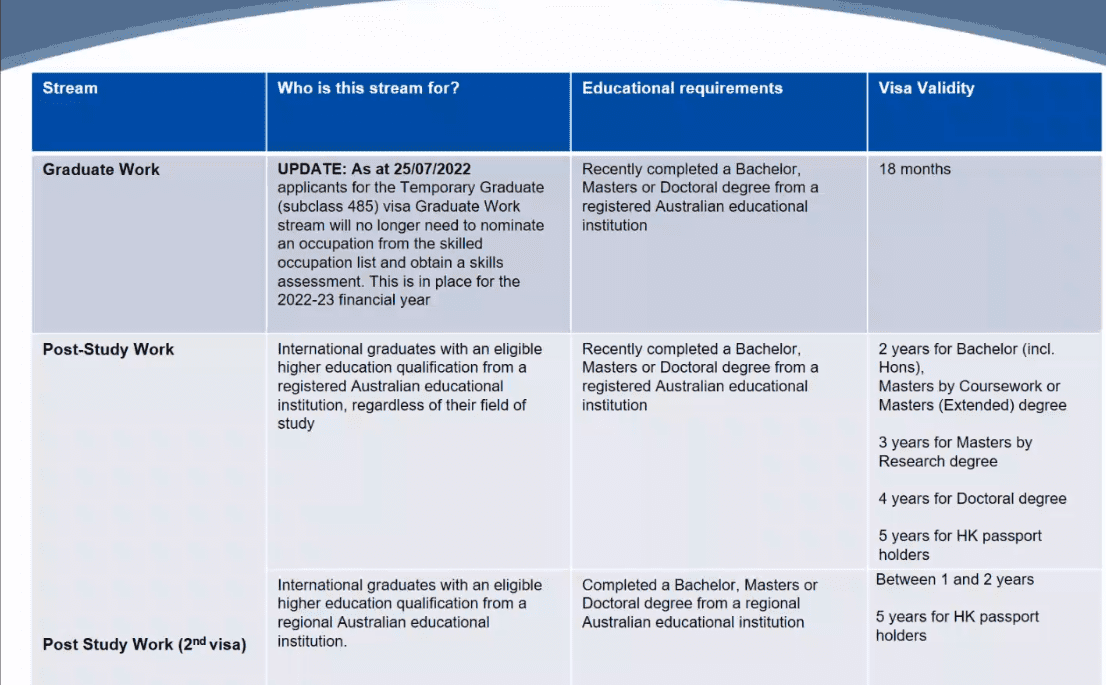
Ended: extended post study work rights for select degrees
From 1 July 2023 to 30 June 2024, the Australian Government increased the duration of post study work rights for select degrees in areas of verified skill shortage:
- Two years to four years for select bachelor degrees
- Three years to five years for select masters degrees
- Four years to six years for select PhDs.
This extension ended on 1 July 2024 and is not available to new applicants.
Online study and the Australian Study Requirement
Online study completed between 1 February 2020 and 25 November 2023 continues to count towards the Australian Study Requirement (ASR). Study completed online after 25 November 2023 does not count.
485 Visa Streams at a Glance (2026)
The stream you apply for depends on the qualification you completed in Australia, not on the job you want. You cannot change streams after you lodge, so choose carefully. The table gives a quick comparison, and the tabs below explain each stream.
| Stream | Who it is for | Stay period | Age limit (main applicant) | Skills assessment |
|---|---|---|---|---|
| Post-Higher Education Work | Bachelor, master’s or doctoral graduates | 2 to 3 years (longer for some passports) | 35 or younger, or under 50 for master’s by research, PhD, Hong Kong and BNO | Not needed |
| Post-Vocational Education Work | Diploma, associate degree or trade graduates | 18 months (5 years for Hong Kong and BNO) | 35 or younger, or under 50 for Hong Kong and BNO | Needed, in an occupation on the MLTSSL |
| Second Post-Higher Education Work | First 485 holders who studied and live in regional Australia | 1 or 2 years, depending on the regional area | 35 or younger | Not needed |
| Replacement | Graduates affected by COVID-19 travel restrictions | Closed to all applicants since 1 July 2024 | ||
Who it is for: international students who have completed a bachelor, master’s or doctoral degree in Australia. This stream was called the Post-Study Work stream before 1 July 2024.
How long you can stay:
| Qualification | Most passport holders | Indian passport holders |
|---|---|---|
| Bachelor degree (including honours) | 2 years | 2 years (3 years for a bachelor with first class honours in STEM, including ICT) |
| Master’s by coursework or extended master’s | 2 years | 3 years |
| Master’s by research | 3 years | 3 years |
| Doctoral degree (PhD) | 3 years | 4 years |
Hong Kong and BNO passport holders can stay for up to 5 years.
Things to know:
- A graduate certificate on its own does not qualify. A graduate diploma only counts in limited cases, for example when it is closely related to a degree you completed and you started it in the same or the following academic year.
- You do not need a skills assessment or a nominated occupation.
Read the full guide to the 485 Post-Higher Education Work stream.
485 Visa Requirements Explained
The Australian study requirement
Your qualification decides your stream, but your study history decides whether you qualify at all. Your study must add up to at least 2 academic years in Australia. In practice this means:
- one or more courses registered on CRICOS, taught in English, that together total at least 92 weeks
- completed over at least 16 calendar months while you were physically in Australia on a student visa
- a degree, diploma or trade qualification as the result (the type of qualification decides your stream)
You can combine courses, but credit you received for study outside Australia may reduce the weeks you can count. Online study completed after 25 November 2023 does not count. Read more about the two year study requirement.
Being in Australia on the right visa
The main applicant must be in Australia when lodging, and must hold a student visa or have held one in the 6 months before applying. If your student visa has expired, you can usually only apply if you are on a Bridging visa A or B from another application. Family members included in your application usually also need to be in Australia at the time of lodgement.
English
Unless you hold a passport from the UK, Ireland, the USA, Canada or New Zealand, you need IELTS 6.5 overall with at least 5.5 in each band, or an equivalent score in another accepted test. The test must have been taken no more than 1 year before you apply, at a test centre, and the result must be provided with your application. Partners and children do not need to meet this requirement. See the full score table on our 485 visa English requirements page.
English test scores for the 485 (tests taken from 7 August 2025)
| Test | Most applicants | Hong Kong and BNO passport holders |
|---|---|---|
| IELTS (Academic or General Training) | 6.5 overall, at least 5.5 in each part | 6.0 overall, at least 5.0 in each part |
| PTE Academic | 55 overall: listening 40, reading 42, writing 41, speaking 39 | 47 overall: listening 33, reading 36, writing 29, speaking 24 |
| TOEFL iBT | 81 total: listening 12, reading 12, writing 14, speaking 17 | 67 total: listening 8, reading 8, writing 9, speaking 14 |
| CELPIP General | 8 overall, at least 6 in each part | 7 overall, at least 5 in each part |
| LANGUAGECERT Academic | 67 overall: listening 49, reading 54, writing 56, speaking 62 | 61 overall: listening 41, reading 44, writing 45, speaking 54 |
OET and the Michigan English Test (MET) are also accepted, each with its own scores. Cambridge C1 Advanced is not accepted for tests taken from 7 August 2025, and tests taken online at home are not accepted. This is a higher standard than the Competent English needed for skilled visas such as the 189 visa (IELTS 6 in each part).
Health insurance
You need adequate health insurance when you apply, and you must keep it for as long as you hold the 485. Student cover (OSHC) is usually accepted at the time of application, but you will need working visa or overseas visitor health cover before your 485 is granted. If you are from a country with a reciprocal health care agreement, you may be able to rely on Medicare instead. Letting your cover lapse can lead to cancellation of your visa.
Health and character
- AFP check: you and each family member aged 16 or over need an Australian Federal Police check. Apply for it before you lodge and include the evidence with your application.
- Overseas police certificates: these may be requested for countries where you lived for 12 months or more in the last 10 years since turning 16.
- Health checks: medical examinations are generally needed, although recent examinations from a student visa may sometimes be reused.
Previous 485 visas
In general, you cannot be granted a 485 as a main applicant if you have already held a 485 or 476 as a main applicant. The main exception is the Second Post-Higher Education Work stream for regional graduates. Holding a 485 as a family member does not stop you from later applying as a main applicant.
Worked Example: Planning Your 485 Timeline
Timing causes more 485 problems than almost anything else, because several deadlines run at once. Here is how they fit together for a typical applicant.
Mei is 27 and finishing a two year master’s degree by coursework at a Melbourne university. Her university notifies her in writing on 12 December 2026 that she has completed her course. Her student visa expires on 15 March 2027, and she sat IELTS in October 2025.
| Deadline or task | Why it matters | Mei’s date |
|---|---|---|
| 6 month window | She must apply within 6 months of completing her course | By 12 June 2027 |
| Student visa expiry | She must lodge while she still holds her student visa (or a bridging visa from another application) | By 15 March 2027 |
| English test | Her October 2025 test will be more than 1 year old, so she needs a new test before she lodges | Book in December 2026 |
| AFP check | She must apply for it before she lodges | Apply in December 2026 |
| Health insurance | Her OSHC must cover her at lodgement, and she needs working visa cover before grant | Arrange before lodging |
Although the 6 month window runs to June, Mei’s real deadline is 15 March 2027, when her student visa ends. If she lodges in January 2027, she will be granted a Bridging visa A that keeps her lawful while her application is processed. As a master’s by coursework graduate she can expect a 2 year Post-Higher Education Work visa, starting from the date of grant.
Tip: your 6 months usually starts from the date your provider first tells you in writing that you have completed your course, which may be earlier than your graduation ceremony. Ask your provider for a completion letter as soon as your results are final.
Step-by-Step: How to Apply for a 485 Visa
- Confirm your stream. Check your qualification type and whether your study meets the Australian study requirement.
- Get your completion letter and transcripts. Ask your provider for a letter that shows your course dates, completion date, campus and study mode.
- Sit your English test. Make sure the test date will be within 1 year of the day you lodge.
- Apply for your AFP check. Do this for yourself and for each family member aged 16 or over.
- Apply for a skills assessment (Post-Vocational Education Work stream only). Lodge it with the assessing authority for your occupation before you lodge your visa application.
- Arrange health insurance. Keep your OSHC active and arrange suitable cover for the 485.
- Lodge online in ImmiAccount and pay the visa charge. Lodge while you are in Australia, within 6 months of completing your course and before your student visa expires.
- Complete health checks and biometrics if asked. Respond to any request from Home Affairs by the date given.
- Check your bridging visa. Your bridging visa usually starts when your student visa ends. Check its conditions in VEVO, and apply for a Bridging visa B before you travel overseas. See our page on bridging visas.
485 visa document checklist
The documents you need depend on your stream and family situation. Click each heading to see what is commonly requested, or see our full 485 visa checklist.
Identity documents
- Passport bio page for you and each family member
- Birth certificates showing parents’ names
- Evidence of any change of name
- A recent passport sized photo for each applicant
Study documents
- Completion letter from each provider showing start and end dates, the date you met the course requirements, campus location, study mode (full time, part time or online) and language of instruction
- Academic transcripts for every course you rely on
- Evidence of any credit or exemptions you received, and where that credit came from
- Evidence of studying at a regional campus, if applying for the Second Post-Higher Education Work stream
English test results
- Your test result from a test taken no more than 1 year before you apply, or
- Your passport, if you hold a UK, Irish, US, Canadian or New Zealand passport
Skills assessment (Post-Vocational Education Work stream)
- Your skills assessment outcome letter, or
- Evidence that you applied to the assessing authority before you lodged your 485 application
Health insurance
- A letter or certificate from your insurer showing your cover and the people it includes
- Evidence of Medicare eligibility, if you rely on a reciprocal health care agreement
Character and health
- AFP check, or evidence that you have applied for one, for each applicant aged 16 or over
- Overseas police certificates, if requested
- Health examinations, booked once you have a HAP ID
Partner and family documents
- Marriage certificate, or evidence of a de facto relationship such as joint leases, joint accounts and shared bills
- Birth certificates of children, and adoption or custody documents if relevant
- Evidence that each family member is in Australia when you lodge, such as their current visa
Living on a 485 Visa: Rights, Conditions and Family
- Work: you can work full time for any employer, in any job, and you can be self-employed. You do not need a job offer to apply.
- Study: you can study while on a 485, but you cannot apply for a student visa while you are in Australia. If you want to study again on a student visa, you would need to apply from outside Australia.
- Travel: once your 485 is granted, you can travel in and out of Australia as often as you like while the visa is valid. Time spent overseas does not extend your visa.
- Health insurance: you must keep adequate health insurance for the whole time you hold the visa.
- When the visa ends: a 485 cannot be extended. Before it expires, you need to move to another visa, such as a skilled, employer sponsored or partner visa, or leave Australia.
Family members and the announced changes
At the time of writing (6 November 2026), you can still include your partner and dependent children in your 485 application if they are in Australia when you lodge. Family members can also apply to join you later as subsequent entrants.
On 17 September 2026, the Government announced that it will restrict the ability of Temporary Graduate visa applicants to include family members, in line with the new student visa rules that started on 2 October 2026. It has also said the changes will not separate families already in Australia. As at 6 November 2026, no start date, legislation or detailed rules had been released for the 485. If you plan to include family members, it is wise to lodge as soon as you are eligible. We will update this page when the new rules are confirmed.
Common 485 Visa Mistakes to Avoid
Most 485 refusals come from missed deadlines or missing documents at lodgement, and many of them cannot be fixed afterwards. Click each one to see how to avoid it.
Letting your student visa expire before you lodge
Many students assume they have a full 6 months after completing their course, but student visas often end only a few weeks or months after course completion. If your student visa expires and you have no bridging visa, you may become unlawful and lose the chance to apply. Check your visa expiry date in VEVO and lodge before it.
Using an English test that is more than 1 year old
For the 485, your test must have been taken no more than 1 year before you apply. A result that was fine for your student visa is often too old by the time you finish your course. Tests taken at home online are not accepted, and your result must be provided when you lodge.
Lodging without an AFP check or skills assessment application
You must apply for your AFP check before you lodge, and Post-Vocational Education Work applicants must also apply for their skills assessment first. Applying for these after lodgement can lead to refusal, so get the evidence ready before you submit.
Choosing the wrong stream
Your stream is decided by your qualification. Bachelor and higher graduates apply in the Post-Higher Education Work stream, while diploma, associate degree and trade graduates apply in the Post-Vocational Education Work stream. You cannot change streams after lodgement, and the visa charge is not refunded if you are refused.
Not meeting the 92 week and 16 month rules
Credit for previous study, a shortened course, online study or time spent outside Australia can leave you short of the Australian study requirement. Check your completion letters and transcripts carefully before you apply, especially if you combined courses.
Letting your health insurance lapse
You need adequate cover at lodgement and throughout your stay. Graduates often let OSHC run out after their course ends and forget to arrange new cover. A gap in cover can delay your grant or put your visa at risk of cancellation.
Applying after your 36th birthday
The age limit is checked on the day you lodge. Unless you are a master’s by research or PhD graduate, or a Hong Kong or BNO passport holder, you must be 35 or younger when you apply. If your birthday is close, lodge early. Read more about the 485 visa age limit.
Travelling overseas on a Bridging visa A
Once your student visa ends, your Bridging visa A does not let you return to Australia if you leave. If you need to travel while waiting for a decision, apply for a Bridging visa B before you go.
Providing false or misleading information
False or misleading documents, including incorrect completion letters or insurance certificates, can lead to refusal under Public Interest Criterion 4020 and a ban on future visas. This applies even if someone else prepared the document for you.
From a 485 Visa to Permanent Residence
A 485 is a temporary visa, so the time you have on it is best used to build the experience, English and points you need for a permanent visa. Most graduates follow one of the routes below. Select a tab to see how each one works.
Visas: 189 Skilled Independent, 190 Skilled Nominated and 491 Skilled Work Regional.
How a 485 helps:
- Australian work experience: 1 year of skilled employment in your nominated or a closely related occupation adds 5 points, rising to 10 points at 3 years. See points for work experience.
- Better English: moving from Competent to Proficient or Superior English adds 10 or 20 points.
- Professional Year: completing an approved Professional Year in accounting, ICT or engineering adds 5 points.
- Study points you may already have: the Australian study requirement and regional study can each add 5 points.
You need a positive skills assessment, an occupation on the relevant list and an invitation through SkillSelect. Your age points fall at 33 and 40, so do not leave it too late. Check your score with the skilled visa points table.
When does my 6 month window to apply start?
It generally starts on the date your education provider first notifies you in writing that you have completed your course, not on your graduation ceremony. You must also lodge before your student visa expires, which is often earlier than the end of the 6 months.
Do I need a job offer to apply for a 485 visa?
No. The 485 is not sponsored, so you do not need a job offer or an employer. Once it is granted, you can work in any job for any employer.
Can I apply for a 485 from outside Australia?
No. The main applicant must be in Australia when lodging. Since 25 November 2023, the visa can be granted whether you are in or outside Australia, so you can travel after lodging if you hold a Bridging visa B or your student visa is still valid.
Can I include my partner after the 2026 family changes?
As at 6 November 2026, yes. The family member restrictions that started on 2 October 2026 apply to student visas. The Government has announced similar restrictions for the 485, but no start date or detailed rules have been released. Your partner usually needs to be in Australia when you lodge, or can apply later as a subsequent entrant.
Can I change my stream or occupation after I lodge?
No. Your stream, and for the Post-Vocational Education Work stream your nominated occupation, are fixed when you lodge. If you choose the wrong one, the application may be refused and the visa charge is not refunded.
What if my English test is more than 1 year old?
You will need to sit a new test before you lodge, unless you hold an exempt passport. Results usually take a few days, so book early if your student visa is close to expiring.
Does my time on a 485 count towards citizenship?
Time you spend lawfully in Australia on a 485 can count towards the 4 year residence requirement for citizenship, but you also need at least 12 months as a permanent resident. Read about the citizenship residency requirement.
How much does a 485 visa cost in 2026?
From 1 July 2026, the visa charge for a first 485 is $5,750 for the main applicant, $2,875 for each additional applicant aged 18 or over and $1,450 for each additional applicant under 18. A second 485 in the Post-Higher Education Work stream costs $2,265 for the main applicant. Passport holders of 13 eligible Pacific island countries and Timor-Leste pay lower charges. You will also need to budget for your English test, AFP check, health checks, insurance and any skills assessment.
What happens when my 485 visa expires?
A 485 cannot be extended. Before it ends, you need to apply for another visa you are eligible for, or leave Australia. Apply for your next visa while your 485 is still valid, so that a bridging visa can keep you lawful while it is processed. Watch for a no further stay condition on any other visa you hold, such as condition 8503.
Can I lodge a 485 if my spouse is overseas?
Generally, no.
For a combined Subclass 485 visa application, all applicants included in the application must usually be in Australia at the time the application is lodged. This requirement applies to both the primary applicant and any secondary applicants, including spouses and dependent children.
There was previously a temporary concession that allowed certain family members to be outside Australia when the application was lodged. However, that concession ended in November 2023.
As a result, in most current cases, a spouse who is included as a secondary applicant on a Subclass 485 application must be in Australia when the application is submitted.
If the spouse is overseas, it may be necessary to consider alternative options, such as lodging the primary applicant’s Subclass 485 application first and exploring whether the spouse can be added later as a subsequent entrant, depending on the circumstances.
How long can Indian nationals stay on a 485 visa?
Under the Australia-India Economic Cooperation and Trade Agreement (AI-ECTA), Indian nationals in the Post-Higher Education Work stream can stay 2 years with a bachelor degree, 3 years with a bachelor with first class honours in a STEM field (including ICT), 3 years with a master’s degree (coursework, extended or research) and 4 years with a PhD. The other 485 rules, such as the age limit, English and the 6 month window, still apply.
What PTE score do I need for a 485 visa?
For tests taken from 7 August 2025, you need PTE Academic 55 overall with at least 40 in listening, 42 in reading, 41 in writing and 39 in speaking. Hong Kong and BNO passport holders need 47 overall with at least 33 listening, 36 reading, 29 writing and 24 speaking. The test must have been taken no more than 1 year before you apply. See the 485 visa English requirements.
Can I get a second 485 visa?
Generally not as a main applicant if you have already held a 485 (or a 476) as a main applicant. The exceptions are the Second Post-Higher Education Work stream for regional graduates and some Hong Kong and BNO passport holders. Holding a 485 as a family member does not stop you from applying later as a main applicant.
Who can apply for the Second Post-Higher Education Work stream?
You must hold, or have held, a first 485 in the Post-Higher Education Work stream (formerly Post-Study Work), have completed your studies at a campus in a regional area, and have kept living in a regional area, generally for at least 2 years immediately before you apply. You must be 35 or younger. The extra stay is 1 year for Category 2 areas and 2 years for Category 3 areas, and graduates who studied and lived in Hobart and nearby postcodes can receive 2 years since 12 September 2025. Read more about the second 485 for regional graduates.
How long does a 485 visa take to process?
Home Affairs figures dated 2 November 2026 showed 90% of Post-Higher Education Work applications decided within 33 days. Post-Vocational Education Work applications took 52 days for 50% and 4 months for 90%, partly because a skills assessment is involved. Complete applications with all documents attached are usually decided faster. See 485 visa processing time.
Pathways after your 485 visa
Many 485 visa holders use their time in Australia to build work experience, improve their English and gain points towards a permanent or provisional visa, such as:
- Skilled Independent 189 visa
- Skilled Nominated 190 visa
- Skilled Work Regional 491 visa
- Skills in Demand 482 visa or Employer Nomination 186 visa with an employer sponsor
Related guides
- 485 Post-Higher Education Work stream
- 485 Post-Vocational Education Work stream
- 485 visa English requirements
- 485 visa checklist
- 485 visa processing time
- 485 visa to PR
- Permanent visa pathways
- Second 485 visa for regional graduates
- 485 visa fees
- Frequently Asked Questions: Graduate Temporary Subclass 485 Visas
- Skilled visas Australia
- Skilled Independent visa (189)
- Skilled Nominated visa (190)
- Skilled Work Regional visa (491)
- Permanent Residence (Skilled Regional) visa (191)
- National Innovation visa (858)
- Skilled visa points table
- Skilled occupation list
- Skilled visa costs and 485 visa fees
- Skilled visa processing times
- Skilled visa assessment
- Book a consultation
Book a meeting today for a commitment free briefing with our Registered Migration Agents in Melbourne to find more about your visa options.