

The Minister has powers under the Migration Act 1958 to intervene in your case when the Minister thinks it is in the public interest to do so.
What is and what is not in the public interest is for the Minister to decide. The Minister is not legally bound to intervene or to consider intervening.
When the Minister intervenes to make a more favourable decision, this usually means that the Minister grants a visa. However, only a small number of all requests for ministerial intervention are successful.
Options that might apply to you:
- You have received a decision by a review tribunal
- You have previously been refused a protection visa or your protection visa has been cancelled
Legal Framework:
Under section 351 of the Migration Act 1958 (Cth), the Minister has the power to intervene in a case, either on their own initiative or at the request of a visa applicant, where they consider it to be in the public interest to do so. The Act does not provide a specific definition of what constitutes the public interest, nor does it provide clear criteria for the exercise of this power. Rather, the decision to intervene is a discretionary one, and the Minister may take into account a range of factors.
When can a Minister consider an Intervention Request?
There are several provisions under which the Minister can consider an intervention request:
- Public interest: If the Minister believes that it is in the public interest or national security to intervene in a particular case, they may use their discretionary power to grant a visa.
- Compassionate and compelling circumstances: The Minister may intervene in cases where there are compelling and compassionate circumstances that warrant special consideration, such as cases involving serious illness, death of a family member, or a situation where an applicant may face significant harm if they return to their home country.
- Australia’s international obligations: The Minister may intervene in a case if it is necessary to meet Australia’s international obligations, such as under the Refugee Convention or other international agreements.
- Administrative error: The Minister may intervene if there has been an administrative error in the visa application process that has resulted in an unfair or unreasonable outcome.
It is important to note that Ministerial Intervention is a discretionary power, and the Minister is not obliged to intervene in any particular case, even if the circumstances appear to meet one or more of the provisions above.
What is the purpose of Ministerial Intervention?
According to the Australian Government Department of Home Affairs, Ministerial Intervention is not an extension of the visa application or review process, it is a “safety net” mechanism that allows the Minister to intervene in certain visa cases where the decision may result in “unfair or unreasonable” outcomes. This power is discretionary. Under the guidelines that applied until September 2025, it was only used in “unique or exceptional” circumstances. Since 4 September 2025, requests are assessed against a set of published criteria (see below).As initially conceived, ‘these discretionary powers were meant to balance what is an otherwise inflexible set of regulations.”
New ministerial intervention guidelines from 4 September 2025
In Davis v Minister for Immigration [2023] HCA 10, the High Court found that the Department had been unlawfully screening out requests under the previous guidelines. In response, the Minister issued new instructions on 4 September 2025. The “unique or exceptional circumstances” test was replaced with objective criteria, and the Department now only refers a request to the Minister if it meets one of those criteria.
Circumstances in which a request may be referred to the Minister include where:
- you are the parent of an Australian citizen or permanent resident child who is under 18 when the request is made;
- you work in a relevant skilled occupation, have the qualifications for it and have the support of your employer;
- you previously held a subclass 188 visa and meet the residence requirements for the subclass 888 visa;
- you are the carer of an Australian citizen with a significant medical impairment and no other family member in Australia can provide the care;
- you were excluded from a protection visa on character grounds but Australia still owes you protection obligations;
- you came to Australia as a minor, have spent at least half your life here, and returning would adversely affect your health;
- you cannot return to your home country because it will not cooperate, for example by refusing to issue a travel document.
Requests are generally not referred where:
- a Minister personally considered and declined an earlier request from you in the last two years (a repeat request), unless there is significant new information;
- you are outside Australia;
- you have another substantive visa application being processed, or a review at the ART is still in progress;
- a court or tribunal has sent your case back to the Department to decide again;
- you are not in detention, could apply for a Bridging visa E and have not done so;
- your claims rely only on protection (non-refoulement) obligations.
How to make a request: the request must be in writing, say which power under the Migration Act you are asking the Minister to use (for example section 351 after an ART decision), identify which criteria you meet, and include all your supporting evidence. Requests that were lodged before 4 September 2025 and not finalised were generally closed, and people affected can lodge a new request under the current criteria.
Ministerial intervention is not a further appeal. Re-arguing the ART’s findings, or relying only on ordinary hardship or a long stay in Australia, is unlikely to succeed. If you are thinking about a request, get advice first, and check whether another option such as a new onshore visa application or court review is available.
Case LawThe most important recent case is Davis v Minister for Immigration, Citizenship, Migrant Services and Multicultural Affairs [2023] HCA 10. Mr Davis and another applicant asked the Minister to intervene after their visa refusals were affirmed by the Tribunal. Departmental officers decided, under the Minister’s guidelines, that their cases did not meet the “unique or exceptional circumstances” test, so the requests were never put to the Minister. The High Court held that the guidelines could not lawfully direct officers to make that kind of evaluative judgment about the public interest, because the Act gives that judgment to the Minister personally. The decision affected thousands of requests and led to the new, criteria-based guidelines that apply from 4 September 2025. The case is significant because it confirms that, while the Minister does not have to consider a request, the process used to decide which requests reach the Minister must stay within the law. Source: Davis v Minister for Immigration, Citizenship, Migrant Services and Multicultural Affairs [2023] HCA 10, High Court of Australia, 8 March 2023. |
Advantages of Ministerial Intervention: |
Disadvantages of Ministerial Intervention: |
| 1. Flexibility: Section 351 of the Migration Act 1958 (Cth) allows the Minister to consider each case on its individual merits and to take into account a wide range of factors beyond the strict legal requirements of the Act. This provides greater flexibility in decision-making and allows for a more compassionate and humane approach. [1]
2. Oversight: The Minister must table a statement in Parliament each time a public interest power is used, and the courts can review whether the Department’s process for handling requests is lawful, as shown in Davis. [2] The Minister’s personal decision whether to intervene, however, cannot be reviewed on its merits. [3] 3. Protection of vulnerable individuals: Ministerial Intervention can provide a safety net for vulnerable individuals who may not be eligible for other forms of relief, such as asylum or refugee status. [4] |
1. Lack of transparency: Ministerial Intervention is a discretionary power, the Minister does not have to consider a request and does not give reasons for declining. This lack of transparency can lead to uncertainty and inconsistency in decision-making. [5]
2. Political influence: The exercise of Ministerial Intervention powers may be subject to political influence, particularly in cases that receive media attention or public scrutiny. This can undermine the integrity of the decision-making process and raise questions about the fairness of outcomes. [6] 3. Delay and uncertainty: Ministerial Intervention can be a lengthy process, and the outcome is uncertain. This can be particularly challenging for individuals who are in detention or who are facing immediate removal from Australia. [7] |
[1]Migration Act 1958 (Cth), s 351
[2] Davis v Minister for Immigration, Citizenship, Migrant Services and Multicultural Affairs [2023] HCA 10
[3] Plaintiff S10/2011 v Minister for Immigration and Citizenship [2012] HCA 31
[4] Minister’s instructions on ministerial intervention, 4 September 2025
[5] Davis v Minister for Immigration, Citizenship, Migrant Services and Multicultural Affairs [2023] HCA 10
[6] Senate Select Committee on Ministerial Discretion in Migration Matters, Report (2004)
[7] Department of Home Affairs, ministerial intervention information (2025)
Minister’s Powers to Intervene
The Act provides the Minister with powers to intervene in individual cases if he thinks it is in the public interest to do so. These are commonly referred to as the Minister’s public interest powers.
For example:
| under section 48B | the Minister can intervene to allow a person who has had a Protection visa (PV) refused or cancelled to make a new PV application onshore |
| under sections 351, 417 and 501J | the Minister can replace a decision of a review tribunal with one that is more favourable to the person concerned |
| under section 345 | the Minister can replace a decision made by a review officer prior to 1 June 1999 with another decision the terms of which were agreed to by the applicant |
| under section 195A | the Minister can grant a visa to a person in immigration detention. |
The Minister’s public interest powers are:
- non-delegable – decisions must be made by the Minister personally or where appropriate by another Minister
- non-compellable – the Minister does not have a duty to consider whether to exercise the powers
- non-reviewable – ministerial decisions made under these powers are not reviewable by the tribunals and cannot be overturned by the courts
- subject to reporting to parliament – the Minister is required to table in parliament a statement of reasons when these powers are used.
Moreover, Under ss 351(1), 417(1), 501J(1) of the Migration Act 1958 (Cth), there are only two preconditions for the exercise of the power, namely, the Minister having decided to consider whether to exercise the power and the Minister thinking that it is in the public interest to do so. As there is no statutory duty to consider any request, ‘no question of procedural fairness arises when the Minister declines to embark upon such a consideration’.[1]
Evidence that can support a request
The table below shows the kinds of evidence that can support a request. Under the current guidelines, the evidence must show that you meet one of the referral criteria listed above.
| Types | Supporting examples |
| · Strong compassionate circumstances that, if not recognised, would result in serious, ongoing and irreversible harm and continuing hardship to an Australian citizen or an Australian family unit (where at least one member of the family is an Australian citizen or Australian permanent resident) | · A statutory declaration outlining how the Australian citizen or permanent resident will suffer ongoing and irreversible harm and continuing hardship, and any reasons why you cannot apply for a visa from outside Australia
· Medical/specialist reports confirming an Australian citizen or permanent resident needs ongoing and continuous care that is not otherwise available and evidence of the efforts you or your family have made to source care from community and other support services; Supporting letter from the Australian citizen or permanent resident to whom you are providing support, or from their family members, |
| Compassionate circumstances regarding your age, health or psychological state, that if not recognised, would result in serious, ongoing and irreversible harm and continuing hardship. | · Documents to support claims that you would suffer serious, ongoing and irreversible harm and continuing hardship if you are returned to your country of origin:
o Evidence of your age (birth certificate or passport) o Evidence of your health status (recent medical/specialist reports) o A statutory declaration outlining how you will suffer irreparable harm and continuing hardship because of your age or ill-health o A letter of support from your family members or from others who are willing to provide you with ongoing care while you are in Australia indicating the nature of the support and care that they are able to provide. |
| Exceptional economic, scientific, cultural or other benefits that would result from you being permitted to remain in Australia. Have you integrated well into the Australian community? | Documents demonstrating why you would be of exceptional benefit to Australia:
· Awards or industry or peer recognition; · Letters of support from relevant national bodies- professional, industry, cultural or sporting bodies; · Evidence of your English language standard such as the results of an International English Language Testing System (IELTS) language test; · Evidence of qualifications, for example degrees or membership of a professional body; · Evidence that your skills are recognised in Australia by a relevant Australian assessment authority; · Employer references showing you have been employed in your profession or trade; · Business or financial statements. · Documents showing participation in or membership of community organisations e.g. sporting clubs, volunteer work, cultural groups |
| You cannot be returned to your country of citizenship due to circumstances outside your control. | Documents supporting your claims:
· Evidence of identity – birth certificate or a genuine travel document issued in your name · Evidence that you cannot get or you have been refused a new travel document by your country of citizenship or the country you usually live in. · Country information that relates to you fears independent information showing you would face this kind of harm. · Did not meet the criteria for the grant of any type of Protection Visa. |
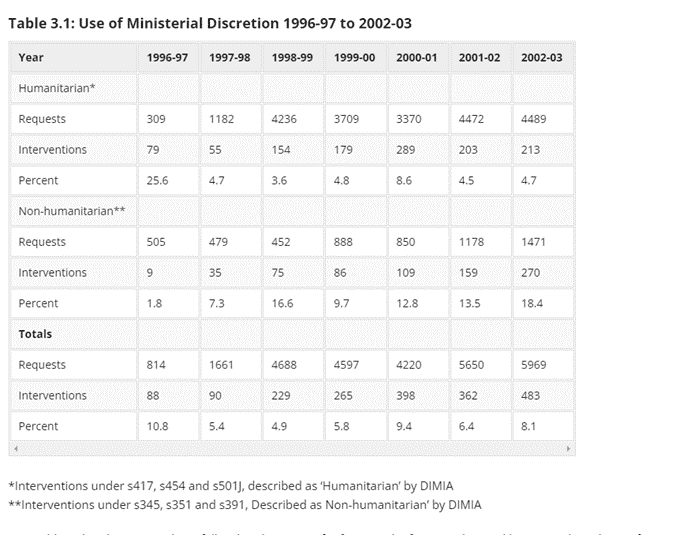
Statistics
The statistics below are from 2012/13, when the Minister intervened in 26% of cases referred under s417 and 44% of cases referred under s351 of the Migration Act 1958. Intervention rates are now much lower. Under the new criteria-based guidelines, only a limited number of requests are referred to the Minister, and the Minister is not obliged to intervene in any of them.
[1] Plaintiff S10/2011 v Minister for Immigration and Citizenship (2012) 246 CLR 636 [50] (French CJ and Kiefel J).
Book a meeting for a commitment free briefing with our Registered Migration Agents in Melbourne to find more about your visa options.


