

Update (October 2026)
The figures in this post are for 2018-19 and are historical. Student visa settings have changed a lot since then: the Genuine Student requirement replaced the GTE test in March 2024, the visa application charge is AUD 2,500 from 1 July 2026, and new rules for families and onshore applicants started on 2 October 2026. See our Student visa (subclass 500) page and student visa changes from 2 October 2026.
In 2018-19, many students choose Australia to be their number one education destination. International students bring approximately $39 billion per year into the economy, making international education the fourth-largest industry in Australia. So which countries do students come from and where do they study?
Enrolments
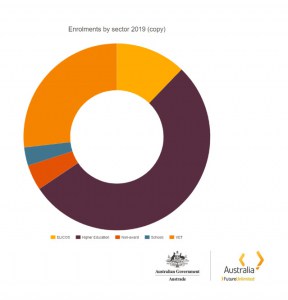
Most international students are enrolled in higher education, but we have international students across all different education sectors. Data from the Australian Trade and Investment Commission revealed that 53% of international students are enrolled in higher education followed by 27% of students in VET. 12% of international students are involved in ELICOS, 4% in non-award and 3% in schools.
Higher Education
VET
ELICOS
Non-Award
Schools
Higher Education
Most higher education students come from China. The data indicated that 39,914 student visas were granted to Chinese nationals. This is followed by India, Vietnam, Sri Lanka, and Indonesia for the 2018-19 period.

Vocational Education and Training Sector
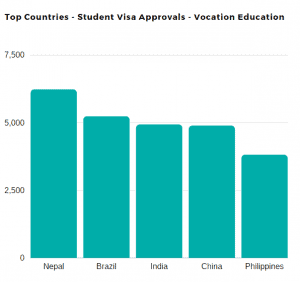
During this period, most students who were granted a visa in vocational education and training sector were from Nepal. 6,230 Nepal citizens were granted a student visa. Following on from Nepal, Brazil, India, China, and Philippines also have high student visa approval rate in this sector.
Top Countries: Student Visa Approvals in Other Sectors
In total there were 48,681 students from China. This is followed by 35,789 students from India, 16,695 students from Nepal and 11,011 students from Brazil. 8,386 student visas were approved for Colombian citizens during the 2018-19 year.

What this means in 2026
Your country of citizenship does not decide whether you get a student visa, but it can affect the evidence you need. Each country and education provider has an evidence level, which sets the financial and English evidence you must provide. China, India, Nepal and Vietnam remain among the largest source countries for international students in Australia.
The biggest change since 2018-19 is that the government now manages the size of the international student program. Here are the key settings for 2026:
| Setting (2026) | What it means for you |
|---|---|
| National Planning Level | 295,000 new international student commencements for 2026, kept at 295,000 for 2027 (announced 15 July 2026). It is a planning level, not a cap. |
| Processing priority | Applications are high priority until your education provider reaches 80% of its allocation, then processed more slowly |
| Genuine Student requirement | You answer questions in the visa form about your study plans and circumstances (since 23 March 2024) |
| Visa application charge | AUD 2,500 for the main applicant from 1 July 2026 |
| Financial capacity | Evidence of at least AUD 29,710 a year for living costs, plus course fees and travel |
| Work rights | Up to 48 hours per fortnight while your course is in session |
Next steps
- Choose a course and provider, and check the provider’s place in the processing queue.
- Prepare your Genuine Student answers and financial evidence early.
- Read our 2 October 2026 changes if you plan to bring family or apply from inside Australia.
- Book a consultation for a student visa strategy.



Your 485 Visa Is Ending and You Have No Next Visa: Your Options
Working and Travelling While Your 485 Visa Is Processed
Moving From a Student Visa to a Partner Visa (820)
Why Is My Student Visa Taking So Long? Processing Priority Explained
Your College Closed or the Provider Defaulted: What Happens to Your Student Visa