

Update (October 2026)
Payment rates, income and assets test limits and waiting period rules are updated regularly, so the dollar figures below may be out of date. Since 1 July 2023 the Age Pension age has been 67. Check current rates and waiting periods with Services Australia before relying on these figures.
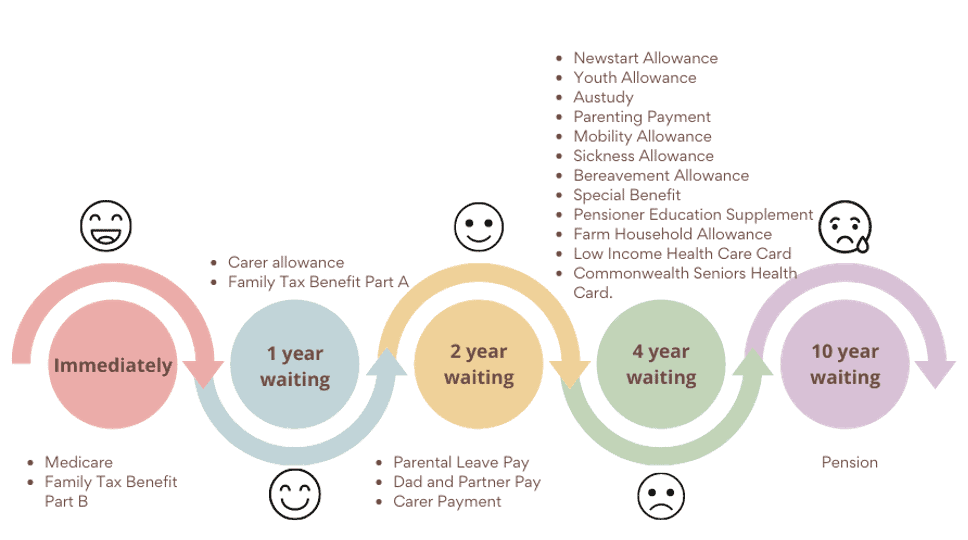
One of the most common and important questions that we have received from our clients is if they are eligible for certain types of social welfare, such as pension, medicare, parental leave, job seeker etc. For most of the welfare payments, new migrants will need to wait for a period of time (from 1 to 10 years) to be eligible.
This article aims to provide you with a summary of waiting periods for welfare payments for new migrants in Australia.
Medicare Benefits
Medicare is the designed for the Australian Government to help Australian and certain visa holders with the cost of their health care. Medicare covers:
- Health check-up
- Medicine
- Mental health
- Screening, tests and scans
- Other chronic disease treatment.
If you have applied for or being granted a certain type of visa as listed below, you are eligible to enrol in Medicare immediately.
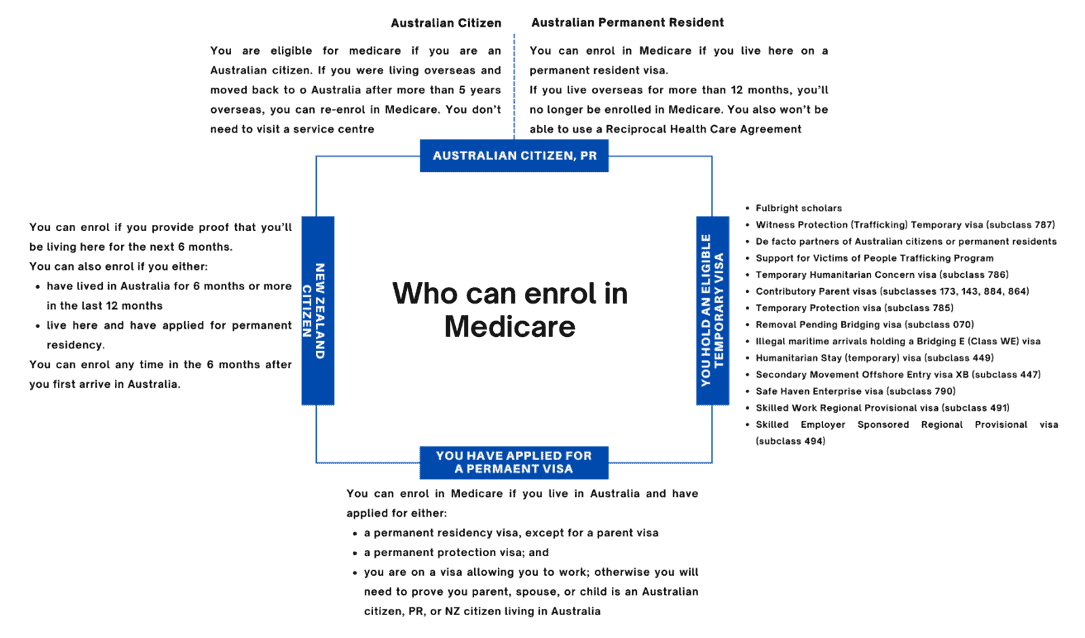
Reciprocal Heath Care Agreements
You might be eligible to enrol in Australian Medicare, and be covered overseas if you are from a country which has a Reciprocal Health Care Agreement with Australia. Those countries include:
- Belgium
- Finland
- Italy
- Malta
- Netherlands
- New Zealand
- Norway
- Republic of Ireland
- Slovenia
- Sweden
- United Kingdom
Pension
To be eligible for Age Pension you must:
- be Age Pension age
- On 1 July 2021, Age Pension age increased to 66 years and 6 months for people born from 1 July 1955 to 31 December 1956, inclusive
- If your birthdate is on or after 1 January 1957, you’ll have to wait until you turn 67. This has been the Age Pension age since 1 July 2023.
- Meet Residence Rules: To get Age Pension you generally need to have been an Australian resident for at least 10 years in total. For at least 5 of these years, there must be no break in your residence. You are exempt from this requirement if you are:
- a refugee or former refugee
- On another payment
- Woman whose partner died
- Lived or worked overseas in an agreement country
- Meet income test: your pension is reduced by 50 cents for each dollars over AUD 180 if you earn over AUD 180 per fortnight for single, or over AUD 320 per fortnight for couple.
- Meet assets test.
Other Social Welfare Payments
The newly arrived resident’s waiting period (NARWP) is time spent in Australia as an Australian resident. This means, if you travel overseas, the time you’re away from Australia won’t count towards the waiting period.
New residents may have to wait up to 4 years before they can:
- get most of our payments
- use most of our services.
A maximum 2 year waiting period applies if you’re the holder of either:
- an Orphan Relative visa (subclass 117 or 837)
- a Remaining Relative visa (subclass 115 and 835).
Proposed Changes from 1 July 2022
In May 2021, the Australian Government said it wanted to change the law for migrants granted a relevant permanent or temporary visa on or after this measure begins. The start date will be 1 January or 1 July after the legislation passes.
If Australia adopts these new laws, newly arrived residents will have to wait 4 years (instead of 2 years as current law) before they can get carer payments and family payments.
Update: these proposed four year waiting periods for carer and family payments did not go ahead as announced. The current waiting periods are set out in the table below.
Exemption to the waiting period
You may not have to wait the newly arrived resident’s waiting period if you’re 1 of these:
- an Australian citizen
- a refugee or former refugee
- a holder of a certain visa subclass and claim certain payments.
You may also not have to wait if you’re a family member of a refugee or humanitarian migrant. This is if you’re a family member at both times when:
- that person arrived in Australia
- you claim a payment or concession.
Waiting periods at a glance (2026)
The table below summarises the usual residence waiting periods for common payments. Waiting periods only count time you spend in Australia as an Australian resident, which generally means as a permanent visa holder living here. Exemptions apply to refugees and humanitarian entrants, and to some family members of Australian residents.
| Payment | Waiting period (approx.) |
|---|---|
| JobSeeker Payment | 4 years (newly arrived resident’s waiting period) |
| Youth Allowance | 4 years |
| Special Benefit | 4 years |
| Parenting Payment | 2 years (qualifying residence period) |
| Carer Payment | 2 years |
| Parental Leave Pay | 2 years |
| Carer Allowance | 1 year |
| Family Tax Benefit Part A | 1 year |
| Family Tax Benefit Part B | No waiting period |
| Age Pension | 10 years of Australian residence in total, including at least 5 years in a row (exemptions apply) |
| Medicare | No waiting period once you hold an eligible visa or have applied for permanent residence (see above) |
Payment rates, income limits and exemptions change regularly, so always confirm your own situation with Services Australia before you plan your finances around a payment.
Does time on a temporary visa count towards the waiting period?
Generally no. The newly arrived resident’s waiting period counts time spent in Australia as an Australian resident, which usually starts when you are granted a permanent visa. Time on a student, work or bridging visa does not normally count. Time you spend overseas after your permanent visa is granted also does not count.
I am on a partner visa. Can I get Centrelink payments?
Most partner visa holders must serve the waiting period like other new residents, so you may need to wait up to 4 years for payments such as JobSeeker. Some family payments have shorter waiting periods (see the table above). See our partner visa guide for the visa process itself.
What is an Assurance of Support and how does it affect payments?
Most parent visas need an Assurance of Support (AoS). The assurer agrees to repay certain social security payments the migrant receives during the assurance period. The AoS period is 4 years for the Parent (subclass 103) and Aged Parent (subclass 804) visas and 10 years for Contributory Parent visas. Plan ahead so that neither you nor your assurer is caught out.
Are refugees and humanitarian entrants exempt?
Yes. Refugees, former refugees and humanitarian visa holders are generally exempt from the newly arrived resident’s waiting period, and some of their family members may also be exempt.
Can I enrol in Medicare before I become a permanent resident?
Often, yes. You can usually enrol once you have applied for an eligible permanent visa (with some conditions), and visitors from countries with a Reciprocal Health Care Agreement can get limited cover while in Australia.



H-1B $100,000 Fee Blocked: What the Proposed $103,265 Fee Means
New US$4,000 H-1B and US$4,500 L-1 Fee on Extensions
US Green Card Changes: Interview Pause and Stricter Public Charge Test
US Visa Bulletin November 2026: Family Dates Jump and EB-2 Moves Forward
US Visitor and Student Visa Changes: ESTA Fee, Visa Integrity Fee and Duration of Status