

For many international students, permanent residence is not one application made immediately after graduation. It is usually a journey with several stages, and the route can change as your circumstances change.
Student Visa → Graduation → Temporary Graduate visa (subclass 485) → Skilled or sponsored pathway → Permanent residence
This is not an automatic process. Completing an Australian course does not guarantee a 485 visa, a skilled invitation, state nomination, employer sponsorship or PR. You must meet the requirements for every visa you apply for.
The useful question is therefore not simply, “Which PR visa should I choose?” It is:
“What can I do after graduation to keep realistic PR pathways open?”
Student Visa → Graduation → 485
For many eligible graduates, the subclass 485 Temporary Graduate visa is the bridge between study and the next stage of their migration journey.
Student Visa → Complete your course → Apply for a 485, if eligible → Build your next pathway
The 485 is a temporary visa, not a PR visa. Its value is the time it may give you to move from being a student into the skilled workforce. During this period, you may gain relevant employment, complete a suitable skills assessment, improve your English score, increase your points, explore state nomination or find an employer willing to sponsor you.
Not every graduate needs to hold a 485 before applying for another visa. Some people may qualify for a skilled or employer-sponsored pathway without it. However, for many students, the 485 is the practical starting point after graduation.
After the 485: Where Can You Go Next?
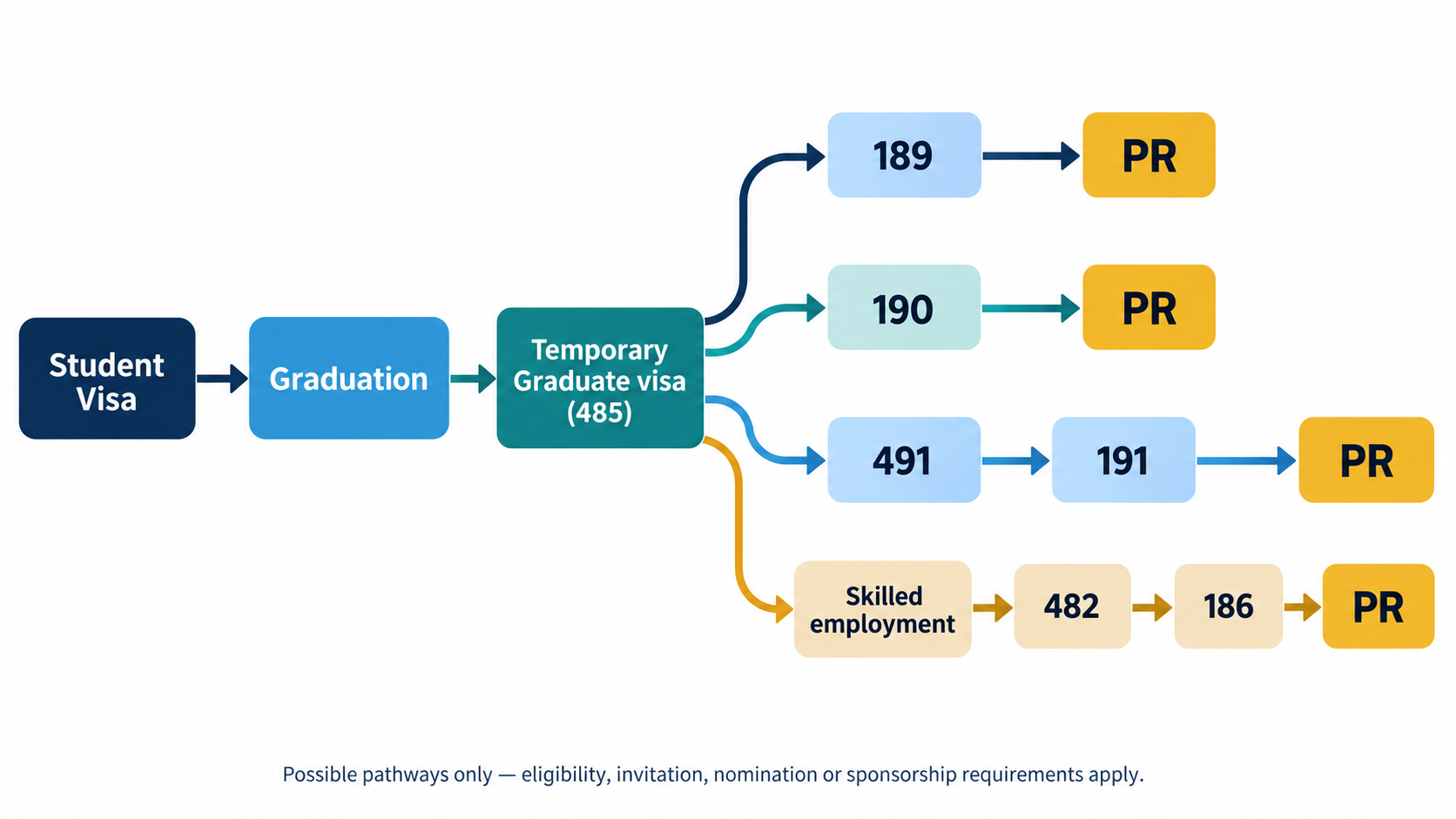 Common pathways after graduation. Each stage has separate eligibility requirements and no pathway is guaranteed.
There is no single “485 to PR” route. Common possibilities include:
| Possible pathway | What usually drives it |
|---|---|
| Student → 485 → 189 → PR | A competitive points score and an invitation for independent skilled migration |
| Student → 485 → 190 → PR | State or territory nomination plus an invitation |
| Student → 485 → 491 → 191 → PR | A regional pathway through state nomination or eligible family sponsorship, followed by meeting the requirements for the 191 visa |
| Student → 485 → 482 → 186 → PR | Skilled employment and an employer willing and able to sponsor and nominate you |
These are common examples, not mandatory sequences. Your actual route will depend on your occupation, skills assessment, English, points, location, work experience, invitation prospects and employer options.
Points-Tested Pathway: 485 → 189 / 190 / 491
The 189, 190 and 491 visas sit within the points-tested skilled migration system. From a graduate’s perspective, the planning process usually looks like this:
485
↓
Suitable skills assessment + English + points + relevant experience
↓
Expression of Interest (EOI)
↓
State nomination (190/491)
↓
Invitation
↓
189, 190 or 491
The same graduate profile may lead to different options.
- 189 may suit someone with a strong points score who can secure an independent skilled invitation.
- 190 may become more realistic if a state or territory is seeking the person’s occupation and agrees to nominate them.
- 491 may provide a regional option through state or territory nomination. If the visa holder later meets the relevant regional residence, visa-condition and other requirements, the 191 visa can provide a pathway to PR.
Submitting an EOI is not a visa application and does not guarantee an invitation. The legal minimum points threshold is only the starting point; actual invitation outcomes depend on competition, occupation demand and available places. You can review VisaEnvoy’s skilled migration points test and recent invitation rounds for further context.
State and territory nomination criteria differ and can change. This is why the 485 period should be used strategically. A better English result, additional skilled experience, professional registration or a move to a state or regional area with a suitable opportunity may change which pathway is realistic.
Employer-Sponsored Pathway: 485 → 482 → 186
Points-tested migration is not the only route.
Student
↓
485
↓
Skilled employment
↓
Skills in Demand visa (482)
↓
Employer Nomination Scheme visa (186)
↓
PR
If you find work that matches your skills and an eligible employer is prepared to sponsor you, your focus may shift from points to employer sponsorship.
In 2026, subclass 482 is the Skills in Demand visa. It is temporary and requires employer sponsorship. A later move to subclass 186 is possible for eligible workers, commonly through the Temporary Residence Transition stream after a period of eligible sponsored employment. The employer must also be willing and eligible to nominate the worker, and all requirements in force at that time must be met.
The key practical point is simple: the job matters, but the employer’s capacity and willingness to sponsor matter too. A skilled role does not automatically create sponsorship, and a 482 visa does not automatically become a 186 visa.
Your Pathway Can Change After Graduation
The PR route you imagine while studying may not be the route you eventually take.
You may begin with:
485 → 189
Then find that state nomination makes this route more realistic:
485 → 190
You may receive a regional opportunity:
485 → 491 → 191
Or suitable employment may open an employer-sponsored route:
485 → 482 → 186
This does not necessarily mean your original plan failed. It means your options changed as your points, employment, state nomination opportunities and employer sponsorship prospects changed.
The strongest approach is to review your pathway early and regularly. Before choosing a course, changing jobs, moving interstate or relying on one visa option, check how the decision affects your occupation, skills assessment, points, nomination and sponsorship prospects.
Your degree may start the journey, but your post-study strategy often determines where the journey can go.
This article provides general information only and is based on settings checked on 18 September 2026. Migration laws, occupation lists, nomination programs and policy settings can change. Obtain advice for your circumstances before making a visa or career decision.



After Graduation in Australia: Key PR Pathways for International Students in 2026
What the New Migration Reforms Mean for You
Australia Stops New International Student Enrolments in Graduate Diploma of Management (Learning)
Left Australia Without a Bridging Visa B?
Australia’s Largest Migration Firm